
Things to Do in Kathmandu: Temples, Markets & More

Activities Highlights
Key takeaways
- Kathmandu Valley holds seven UNESCO World Heritage monument zones, inscribed together in 1979, so much of what you want to see already carries global heritage status.
- Give yourself two full days in and around Kathmandu before a trek and one after, which covers acclimatization, gear shopping, and the main sites without rushing.
- Boudhanath, Swayambhunath, and the three Durbar Squares in Kathmandu, Patan, and Bhaktapur are the anchor visits; everything else fits around them.
- Thamel is the practical base for trekkers: gear shops, permits help, restaurants, and short walks to the old city are all within reach.
- Booking Kathmandu as part of a guided itinerary means your city days, permits, and trek logistics are handled by one operator instead of pieced together on arrival.
Most travelers arrive in Kathmandu with a trek on their mind and a day or two to spare, and the honest answer is that those spare days are worth planning as carefully as the mountains. The city packs several centuries of Buddhist and Hindu heritage, three medieval palace squares, and one of the best gear-shopping streets in Asia into a compact valley you can move through in a couple of days. This guide walks through the things to do in Kathmandu that genuinely earn your time: the temples, the markets, the day trips, and how to fit them around a trek without exhausting yourself before you have even started walking.
Kathmandu sits at roughly 1,400 meters in a bowl-shaped valley, so the climate is gentle compared with the high Himalaya and the sites are close together. What follows moves from the essential UNESCO monuments outward to the old cities, the crafts, and the practical question every trekker asks: how long to stay, and when.
The Best Things to Do in Kathmandu Start With the UNESCO Sites
The single most useful thing to understand about sightseeing here is that the Kathmandu Valley is a UNESCO World Heritage Site, inscribed in 1979 and made up of seven separate monument zones (UNESCO World Heritage Centre). Those seven zones are the three royal Durbar Squares in Kathmandu, Patan, and Bhaktapur, plus the Buddhist stupas of Swayambhunath and Boudhanath and the Hindu temple complexes of Pashupatinath and Changu Narayan. In practice this means you are not choosing between a handful of ordinary attractions. You are choosing which parts of a single, protected cultural landscape to prioritize.
If your time is short, treat Boudhanath, Swayambhunath, and Kathmandu Durbar Square as the core inside the city, then add Patan and Bhaktapur as day trips. That covers five of the seven zones and gives you both the sacred sites and the medieval city squares.
Boudhanath: The Valley's Great Stupa
Boudhanath is the site most first-time visitors remember. It is the largest stupa in Nepal, a massive white dome rising about 36 meters to the top of its spire, topped by the painted eyes of the Buddha that look out in four directions. It sits roughly 11 kilometers northeast of the old city, on what was historically the trade route to Tibet, which is why the neighborhood around it has a strong Tibetan Buddhist character.
The way to experience Boudhanath is to do what the pilgrims do: walk clockwise around the base, a circuit called a kora. Monks, Tibetan families, and travelers all move in the same direction, spinning the prayer wheels set into the outer wall. Come in the late afternoon, when butter lamps are lit and the circuit fills with people, and take a table at one of the rooftop cafes that ring the square for a view down onto the dome. If you are interested in the living culture behind the architecture, the surrounding monasteries hold public prayer sessions that visitors can quietly observe.
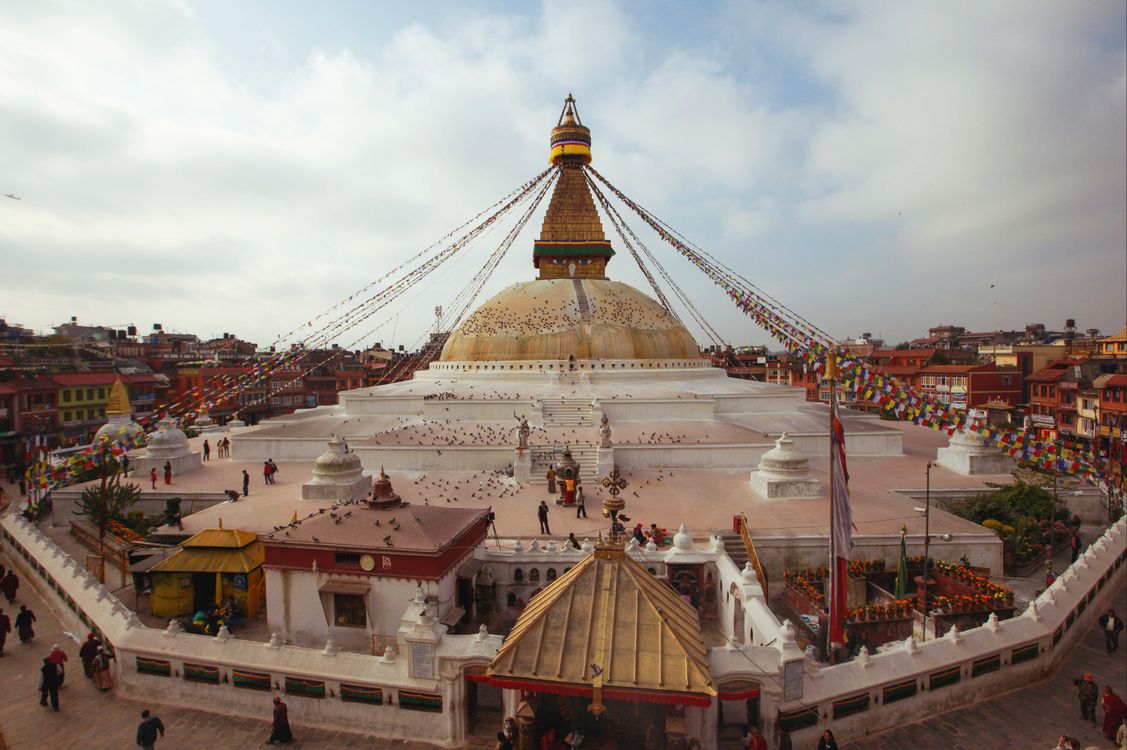
From above, Boudhanath Stupa reveals its mandala design, with the all-seeing Buddha eyes gazing across the courtyards below.
Swayambhunath: The Hilltop Temple
Swayambhunath sits on a hillock about 3 kilometers west of the center and is one of the oldest religious sites in the valley, with origins the Nepal Tourism Board traces to 460 AD (Nepal Tourism Board). Foreign visitors often call it the "Monkey Temple," after the troops of rhesus monkeys that live on the wooded slopes, though the name locals use is the older one.
The classic approach is the eastern stairway of 365 stone steps, one for each day of the year. It is a genuine climb, so pace yourself, especially if you have just arrived and are not yet acclimatized. At the top you get a stupa complex with the same watchful Buddha eyes as Boudhanath, a scatter of smaller shrines that mix Buddhist and Hindu worship, and one of the widest views over the whole Kathmandu Valley. Early morning is best for both the light and the cooler air on the steps.
Kathmandu Durbar Square and the Old City
Kathmandu Durbar Square, also called Hanuman Dhoka, was the seat of the old royal court and remains the ceremonial heart of the old city. The square is a dense cluster of pagoda temples, courtyards, and the former palace, and it is where you will find the Kumari Ghar, the residence of the Kumari, a young girl venerated as a living goddess who occasionally appears at a carved window.
Some structures here were damaged in the 2015 earthquake and have been undergoing careful restoration, so expect to see scaffolding and ongoing conservation work alongside the finished monuments. This is worth knowing rather than being disappointed by: you are watching a heritage site being kept alive. Foreign visitors pay an entry fee for the square, and the ticket is checked at the pedestrian entrances, so keep it with you while you wander. Give the square a slow hour or two and let yourself get lost in the lanes of the surrounding old town, where hardware shops, shrines, and courtyards sit side by side.
Exploring Thamel: Shops and Cuisine
Thamel is the tourist district, and for trekkers it is the most useful square kilometer in the country. Its narrow lanes are lined with shops selling trekking gear, down jackets, sleeping bags, woolen goods, singing bowls, prayer flags, and thangka paintings, along with bookshops, travel agencies, and money changers. If you have forgotten a piece of equipment, this is where you replace it, and a quick read of a Nepal trekking packing list before you shop will keep you from buying things you do not actually need.
A few practical notes on shopping here. Gear ranges from genuine brand-name equipment to convincing copies, and prices reflect that, so check zips, seams, and labels if quality matters for a long trek. Bargaining is normal and expected in the smaller shops, done politely, though many restaurants and fixed-price stores do not haggle. Cash in Nepali rupees is king in the small stalls.
On the food side, Thamel is where Nepali cooking meets the world. The dish to try first is the national staple, dal bhat, a plate of rice, lentil soup, curried vegetables, and pickles that is refillable at many local places and is exactly the kind of fuel you want before a trek. Momos, the steamed or fried dumplings that Nepal shares with Tibet, are everywhere and worth working through. You will also find Newari specialties, Tibetan thukpa noodle soup, and a full run of international restaurants for the nights you want something familiar. Rooftop tables are common and a good way to escape the street noise.
Day Trip to Patan
Patan, officially Lalitpur, sits just across the Bagmati River, only about 5 kilometers from the center, which makes it an easy half-day trip. Its Durbar Square is, for many visitors, the finest of the three, a compact stage of stone and wood temples facing the old royal palace, much of which now houses the Patan Museum. The museum is genuinely excellent, one of the best in South Asia for understanding Nepali religious art, and it is the single indoor stop most worth your time if the weather turns.
Patan is also the traditional home of the valley's finest metalworkers and woodcarvers. Wander the lanes behind the square and you will pass open workshops where artisans hammer copper, cast bronze, and carve statues using techniques passed down for generations. It is the best place in the valley to watch craft being made rather than just sold.
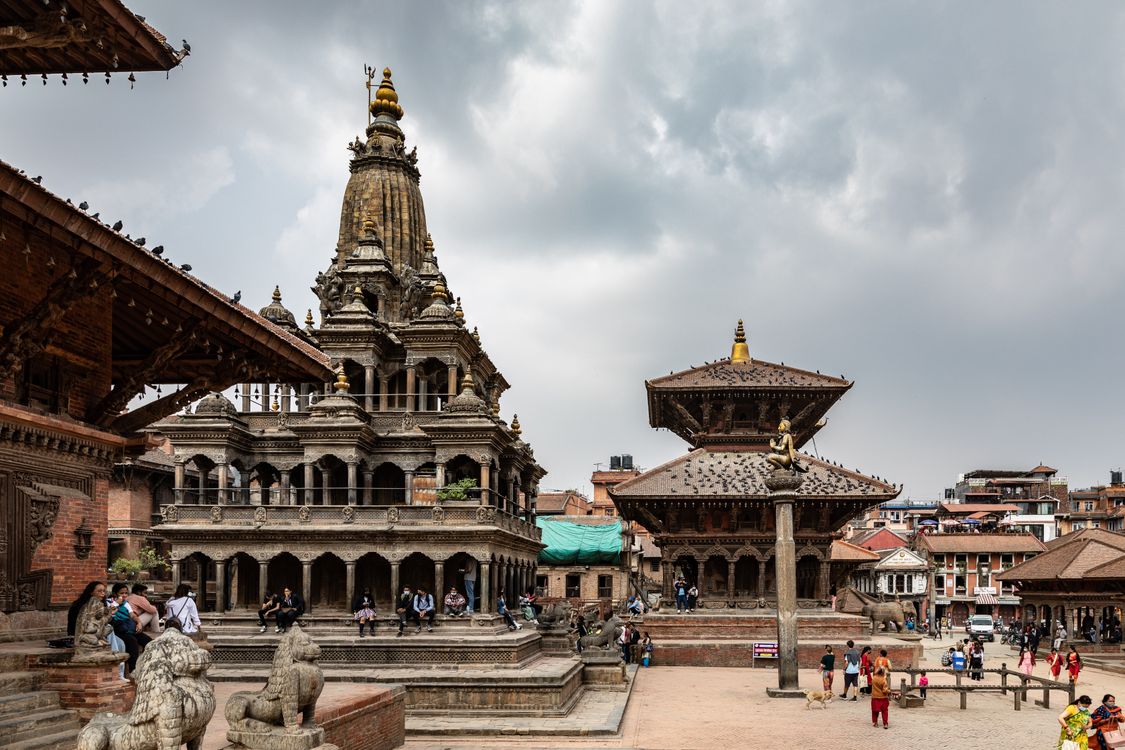
The intricate woodwork and tiered pagodas of Patan Durbar Square showcase centuries of Newari craftsmanship.
Day Trip to Bhaktapur
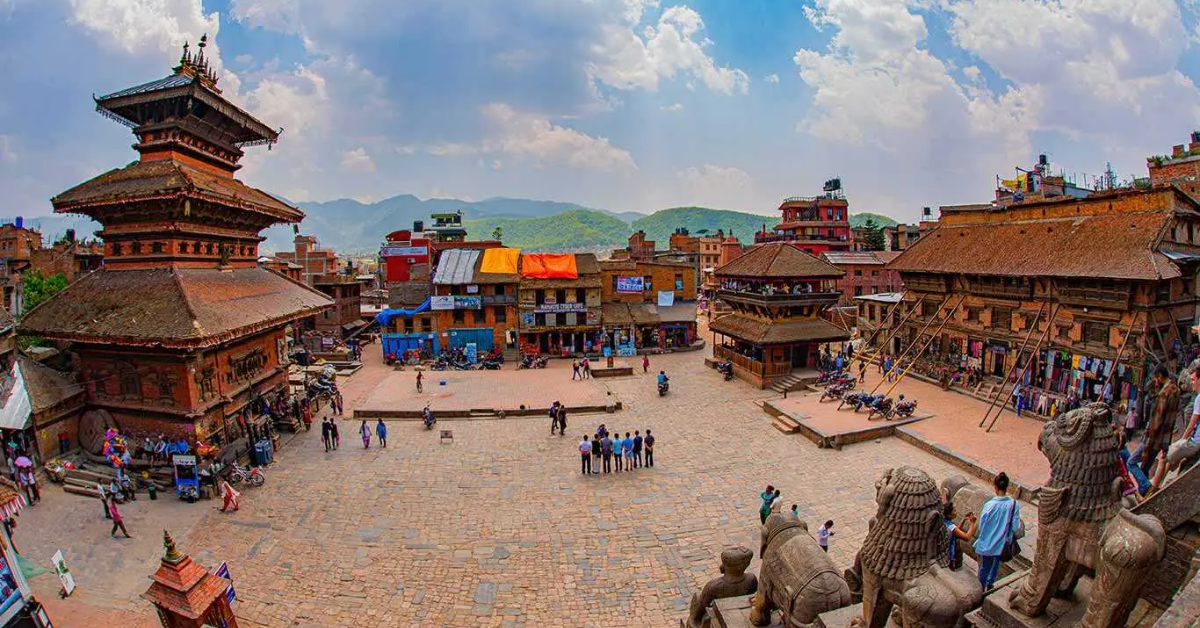
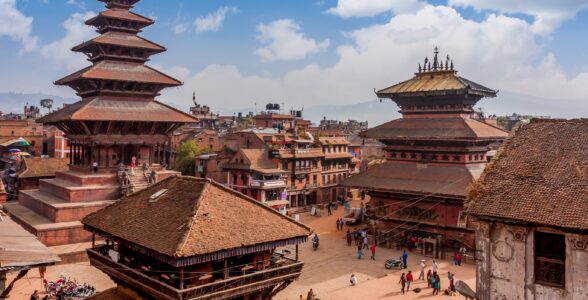
Bhaktapur lies about 13 kilometers east of Kathmandu and rewards a full day rather than a rushed morning. It is the most intact of the old cities, with far less traffic in its core and a lived-in medieval atmosphere that the other squares have partly lost to modern development. Its Durbar Square opens onto a series of connected plazas, including Taumadhi Square with the towering five-storey Nyatapola Temple and the potters' square where clay is still thrown and dried in the open air.
Bhaktapur is also the place to slow down and eat well. It is famous for juju dhau, a thick, sweet buffalo-milk yogurt served in clay bowls, and buying one straight from a local shop is part of the experience. Because Bhaktapur is a walled old town, the best approach is simply to walk, get lost among the brick lanes, and let the squares reveal themselves. Give it the better part of a day and you will understand why many travelers rank it as their favorite stop in the valley.
Cultural Experiences and Local Crafts
Beyond ticking off monuments, Kathmandu is a good place to engage with living tradition. Several kinds of experiences are worth building in.
- Craft and workshop visits. In Patan and Bhaktapur you can watch metal casting, wood carving, pottery, and thangka painting up close. A number of studios welcome visitors and explain the process, which turns a souvenir into something you understand.
- Prayer and ritual, respectfully observed. Morning and evening prayers at Boudhanath, aarti at Pashupatinath, and quiet visits to working monasteries all let you see the culture in motion. Watch quietly, follow the clockwise direction around stupas, remove shoes where required, and ask before photographing people.
- Newari cuisine done properly. The valley's indigenous Newar community has its own distinct food tradition, from bara lentil pancakes to samay baji feast platters. A dedicated Newari meal is a cultural experience in itself.
- Cooking and craft classes. Short momo-making or singing-bowl sessions are common in Thamel and Patan and suit travelers with a spare half-day.
One site deserves a specific mention here because it is unlike anything else on the list. Pashupatinath, on the banks of the Bagmati River, is the most important Hindu temple in Nepal and an active cremation ground, where open-air funeral rites take place daily on the stone platforms along the water. The main temple courtyard is closed to non-Hindus, but you can watch respectfully from the terraces across the river. It is confronting for some visitors and deeply moving for others, and it offers a window into how death and ritual are woven openly into daily life. Go with the understanding that this is a place of grieving families, keep your camera down near the ghats, and let a guide explain what you are seeing.
On buying crafts, a little care goes a long way. Genuine handmade pieces, a hand-knotted carpet, a cast bronze statue, a hand-painted thangka, cost more than machine-made versions for good reason, and Patan and Bhaktapur are more reliable than Thamel for the real thing. Prayer flags, singing bowls, pashmina, and Nepali tea travel well and make honest gifts.
Getting Around and Practical Basics
A few logistics make the sightseeing smoother. Distances inside the valley are short, but traffic is heavy and the air can be dusty, so plan for journeys to take longer than the map suggests.
- Transport. Metered and app-based taxis (Pathao and inDrive are widely used) are the easiest way to reach Boudhanath, Swayambhunath, Patan, and Bhaktapur. Agree a fare or use the app before you set off. Hiring a car with a driver for a full day is inexpensive and sensible if you want to combine two or three sites.
- Money. Nepali rupees are essential for temples, small shops, and taxis. ATMs are common in Thamel but often cap withdrawals, so draw cash in advance of a busy day. Larger hotels and restaurants take cards; street stalls do not.
- Air and pace. The valley's air quality dips in the dry pre-monsoon months, and construction dust is constant. A light scarf or mask is worth carrying. Because you may not be acclimatized on arrival, keep the first day gentle.
- Dress and etiquette at temples. Cover shoulders and knees at religious sites, remove shoes where signs indicate, and never point your feet at a shrine or a person. Some inner sanctums are closed to non-Hindus, notably at Pashupatinath, and that boundary should simply be respected.
- Timing your visits. Mornings are calmer and cooler at Swayambhunath and the Durbar Squares; late afternoon is the atmospheric hour at Boudhanath. Saturdays and festival days bring far larger local crowds, which can be a highlight rather than a hassle if you plan for it.
If your dates coincide with a festival such as Dashain, Tihar, or Indra Jatra, expect some shops and offices to close but the temples and squares to come alive with processions and ritual. It is one of the best times to see the culture, provided you are relaxed about a slower pace.
How Long to Spend Before or After a Trek
This is the practical question, and the honest answer is that it depends on your trek and your international flight schedule, but a simple rule works for most people: two full days before, one day after.
The two days before a trek do double duty. They let your body begin adjusting to altitude, gently, before you go higher, and they give you time to sort gear, permits, and any last purchases in Thamel without panic. A relaxed schedule might look like this:
- Arrival day. Land, get to your hotel, rest, and do nothing more strenuous than an evening walk and dinner in Thamel. Jet lag plus altitude is not the day to climb 365 steps.
- Day one of sightseeing. Boudhanath in the morning, Swayambhunath or Kathmandu Durbar Square in the afternoon, gear shopping and permit checks worked in around them.
- Day two of sightseeing. A day trip to Bhaktapur or Patan, plus your pre-trek briefing and final packing.
The day after a trek matters just as much and is easy to underestimate. You come off the trail tired, often a day behind schedule because of weather or flight delays out of the mountains, and you will want a buffer before your international flight. Use that day for the sites you missed, a proper meal, a massage, and picking up gifts. Building in a single spare day in Kathmandu after a trek is one of the cheapest forms of insurance against a missed flight home.
Some travelers should plan more than the standard three days. If you are interested in art, architecture, or religion for its own sake, the valley can absorb four or five days easily once you add Pashupatinath, Changu Narayan, and the smaller temple towns of Kirtipur and beyond. Families and older travelers often prefer a gentler, culture-first trip that treats Kathmandu and the valley as the destination rather than the gateway, with day trips instead of a trek.
There is also the connecting-journey case. Kathmandu is the natural launch point for trips into Tibet and Bhutan, and if you are combining countries it makes sense to give the city more time on the front end while you sort permits and adjust. Travelers heading north toward Tibet on a small-group tour frequently spend several days in Kathmandu first, both for the sights and for the practicalities of the onward route.
Adding Kathmandu to a Mission Nepal Itinerary
The simplest way to handle the city is to treat it as part of the trip rather than a loose set of errands you improvise on arrival. When Kathmandu is built into a guided itinerary, the city days, airport transfers, trekking permits, and pre-trip briefing all sit with one operator, which removes most of the friction that catches independent travelers, especially around permits and internal flight timing.
Mission Nepal Holidays is a Kathmandu-based operator that arranges the city portion alongside its treks and tours, so a typical trip includes arrival days for sightseeing and acclimatization, a briefing, the trek itself, and a buffer day back in the capital at the end. The advantage is coordination: your guide knows your flight times, your permits are handled before you land, and your city days are scheduled so you are neither rushed nor idle. Exact day counts and inclusions vary by package, so confirm the Kathmandu portion when you book.
Kathmandu is not a place to pass through on the way to the mountains. It is the cultural front door to the entire Himalaya, and a few well-planned days here will make the whole trip better. Pick two temples, one old city, and one day trip, leave a buffer day at the end, and let an operator handle the permits so your time on the ground goes to the things you actually came to see. When you are ready to line up those days with a trek, talk to Mission Nepal Holidays about fitting Kathmandu into your itinerary.
Frequently asked questions
How many days should I spend in Kathmandu?
Plan two full days before a trek and one after. That gives you time to see the main UNESCO sites, shop for gear in Thamel, and rest without feeling rushed.
Is Kathmandu worth visiting on its own, not just before a trek?
Yes. Between the seven UNESCO monument zones, the old cities of Patan and Bhaktapur, and the living Buddhist and Hindu traditions around Boudhanath and Pashupatinath, Kathmandu holds several days of genuine interest on its own.
Do I need to pay to enter the Durbar Squares?
Foreign visitors pay entry fees at the Durbar Squares in Kathmandu, Patan, and Bhaktapur. Rates change periodically, so confirm the current amount when you arrive or ask your guide.
What is Thamel and why do trekkers stay there?
Thamel is Kathmandu's main tourist district, packed with trekking gear shops, restaurants, budget hotels, and travel agencies. It is the practical base for anyone heading to the mountains.
Can Kathmandu be added to a trekking itinerary?
Yes. Most guided trips build in Kathmandu days for arrival, permits, and briefings. Mission Nepal Holidays arranges the city portion alongside the trek so the logistics stay under one operator.