
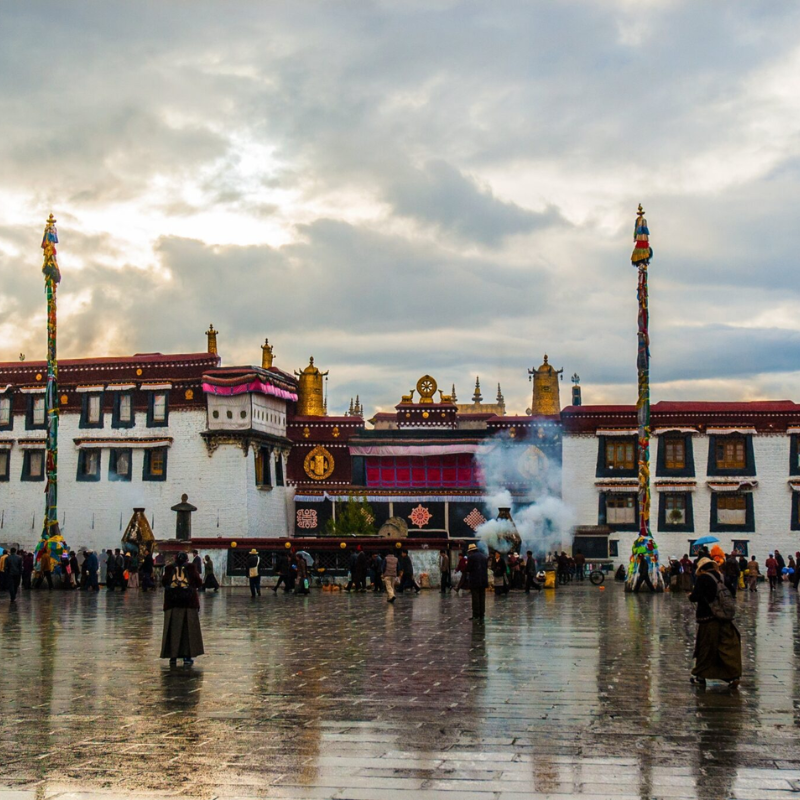
Exploring Jokhang Temple: A Traveler’s Handbook
Activities Highlights
At the center of Lhasa’s Old Town, surrounded by incense smoke, spinning prayer wheels, and pilgrims prostrating on worn stone, sits Jokhang Temple — the most sacred building in Tibet. This handbook covers what you need to know before visiting: the temple’s history, what’s inside, how to get tickets, and the etiquette that will help you visit respectfully.
Whether you’re planning a Lhasa itinerary or just want to understand why this modest-looking temple outranks even the Potala Palace in spiritual importance for Tibetans, here’s what to know about Jokhang Temple. Here is complete Lhasa Travel Guide.
What Is Jokhang Temple?
Jokhang Temple sits at the heart of Barkhor Square in Lhasa’s old town, and it’s widely considered the most revered temple in Tibetan Buddhism — a status that outweighs its relatively modest size compared to the Potala Palace nearby. Historians generally date its founding to sometime in the mid-7th century, during the reign of Emperor Songtsen Gampo, who unified Tibet and helped establish Buddhism in the region.
The temple houses the Jowo Rinpoche (also called Jowo Shakyamuni) — a statue widely regarded as Tibetan Buddhism’s most sacred object — and functions as the endpoint of pilgrimages that, for some devotees, involve months of prostrating their way across the Tibetan plateau. In 1994, UNESCO inscribed the temple as a World Heritage Site alongside the Potala Palace.
The History of Jokhang Temple
Founding and the Two Princesses
According to Tibetan tradition, Songtsen Gampo built Jokhang Temple to house a sacred Buddha statue brought to Tibet as part of his marriage to a Nepalese princess, traditionally known as Bhrikuti. To house a second statue brought by his Chinese wife, Princess Wencheng, he built the nearby Ramoche Temple. It’s worth noting that historians have long debated how much of this princess-founding story is verified history versus later tradition — what’s well documented is that Newar (Nepalese) artisans worked extensively on the temple’s earliest construction, leaving a lasting architectural fingerprint still visible in some of the oldest wooden carvings today.
Where the Name “Lhasa” Comes From
One of the more interesting Jokhang Temple facts is that the city of Lhasa is named after it. The temple was built on a filled-in lake, and according to legend, goats carried the soil used to fill it — which is why the city was originally called “Rasa,” meaning “goat’s place.” After the temple was completed and named “Jokhang” (House of the Jowo), the city became known as “Lhasa” — “land of the Buddha.”
Centuries of Expansion
The temple visitors see today isn’t a single 7th-century structure — it’s the result of construction phases spanning more than a thousand years. Major renovations and additions occurred in the 11th century, the 14th century under Tsongkhapa (founder of the Gelug school), and again in the 17th and 18th centuries under the 5th Dalai Lama’s government, which added outer courtyards and expanded the main entrance. Sections of the original 7th-century woodwork — door frames and pillars carved by Newar artisans — still survive inside.
The 2018 Jokhang Temple Fire
On February 17, 2018, a fire broke out in an upper section of the temple as Lhasa was beginning Losar (Tibetan New Year) celebrations. The fire was extinguished quickly, and by spring of that year the temple had reopened to pilgrims with its most sacred relics, including the Jowo Rinpoche statue, undamaged.
The Jowo Rinpoche: Jokhang Temple’s Buddha Statue
The Jowo Rinpoche is a life-sized statue depicting Shakyamuni Buddha at age twelve, and it’s the single most venerated object in Tibetan Buddhism. One detail that trips up a lot of online sources: you’ll sometimes see the statue described as “2,500 years old,” which refers to Buddhist tradition holding that the statue was consecrated during the historical Buddha’s own lifetime — roughly 2,500 years ago — not to when it arrived in Tibet. Its actual arrival in Lhasa dates to the 7th century, brought as part of Wencheng’s dowry.
The inner chapel housing the statue is reserved primarily for Tibetan worshippers, but visitors can view the Jowo Rinpoche from a respectful distance in the main assembly hall, where it sits adorned in gold and precious stones amid a haze of butter lamp smoke.
Jokhang Temple Architecture
The temple complex spans roughly 25,000 square meters and blends Tibetan, Nepalese, Chinese, and Indian architectural influences — a direct result of the different craftsmen who worked on it across different eras. Its most recognizable feature is the golden rooftop, decorated with dharma wheels and deer sculptures symbolizing Buddha’s first sermon.
Inside, the layout follows a mandala-like design: a central shrine surrounded by radiating chapels, connected by courtyards where monks gather for ceremonies. Multiple floors — accessed by narrow, steep staircases with no elevator access — hold additional chapels, the former living quarters of past Dalai Lamas, and a rooftop terrace with sweeping views over Lhasa and the Potala Palace.
What’s Inside Jokhang Temple
Beyond the Jowo Rinpoche, a visit inside Jokhang Temple typically takes you past:
- The four Guardian Kings flanking the main entrance
- Chapels dedicated to Padmasambhava, Maitreya, and Avalokiteshvara, among other figures
- Murals stretching nearly a kilometer depicting Buddha’s life and Tibetan history
- A rooftop terrace offering some of the best photo views in Lhasa
Planning Your Visit to Jokhang Temple
Tickets and Reservations
During peak travel months, visits to Jokhang Temple typically require a reserved, timed entry, and international visitors generally need to be accompanied by a licensed guide. Because reservation systems and visiting hours are managed locally and can change with the season, it’s worth confirming current requirements directly with your tour operator before you travel rather than relying on older published information.
Opening Hours
The temple is generally open daily, though exact hours can shift seasonally between summer and winter. Mornings tend to draw the largest crowds of local pilgrims performing their daily devotions, while afternoons are typically quieter and easier for visitors to navigate — which is also why many Lhasa itineraries pair a morning at Potala Palace with an afternoon at Jokhang.
How Long Should You Spend There?
Most visitors spend somewhere between 1.5 and 3 hours at Jokhang Temple, depending on how much time you want to spend exploring the chapels versus walking the Barkhor circuit outside.
Dress Code and Photography
Dress modestly — shoulders and knees covered is the general standard. Photography is typically allowed in the courtyards but not inside the chapels and prayer halls, out of respect for the religious relics housed there.
Etiquette at Jokhang Temple
Because this remains an active site of daily worship, a few customs matter more here than at a typical museum:
- Walk clockwise through the temple and around the Barkhor circuit outside, in keeping with Tibetan Buddhist tradition.
- Don’t touch statues, murals, butter lamps, or offerings.
- Give pilgrims space, especially those performing prostrations — avoid close-up photography of people in devotion without asking first.
- Keep your voice low inside the halls; for many visitors around you, this is an act of worship, not sightseeing.
- Wear comfortable, sturdy shoes — the stairways are narrow, steep, and uneven in places.
Best Time to Visit Jokhang Temple
Jokhang Temple is open year-round, but a few periods stand out:
- Tibetan New Year (Losar): The temple becomes the center of major celebrations, with crowds in traditional dress and elaborate rituals — an extraordinary time to visit, though also the busiest.
- Saga Dawa (typically May–June): A month-long festival commemorating Buddha’s birth, enlightenment, and parinirvana, culminating in a major prayer ceremony at the temple. Read more about Saga Dawa
- Winter months: Quieter for tourists but busier with local pilgrims, since many Tibetans travel to Lhasa for pilgrimage after the autumn harvest — arguably the most authentic time to witness devotional life here.
Barkhor Street: The Pilgrimage Circuit Around the Temple
No visit to Jokhang Temple is complete without walking the Barkhor kora — the pilgrimage circuit that encircles it. A full clockwise loop takes about 30 minutes at an unhurried pace, past market stalls selling prayer wheels, thangka paintings, and traditional jewelry, alongside pilgrims spinning prayer wheels and murmuring mantras. Early morning is when the circuit feels most authentic, before the tourist crowds build.
Frequently Asked Questions
How old is Jokhang Temple? Most historians date its founding to the mid-7th century, making it roughly 1,300–1,400 years old, though the current complex reflects major renovations added over the following centuries.
What is the Buddha statue inside Jokhang Temple called? It’s called the Jowo Rinpoche, or Jowo Shakyamuni — widely regarded as the most sacred statue in Tibetan Buddhism.
Is Jokhang Temple older than Potala Palace? Yes. Jokhang Temple’s origins predate the Potala Palace’s major 17th-century reconstruction by roughly a thousand years, even though both sites have layers of later construction.
Can tourists go inside Jokhang Temple? Yes, though visits typically require a reserved time slot during peak season and a licensed guide, and some inner chapels are reserved primarily for Tibetan worshippers.
Is photography allowed inside Jokhang Temple? Photography is generally permitted in the courtyards but not inside the chapels and prayer halls.
What happened in the 2018 Jokhang Temple fire? A fire broke out in an upper section of the temple in February 2018. It was extinguished quickly, and the temple’s most sacred relics, including the Jowo Rinpoche statue, were undamaged.
Why is Jokhang Temple important to Tibetan Buddhism? It houses the Jowo Rinpoche, considered the most sacred Buddhist statue in Tibet, and serves as the ultimate pilgrimage destination for Tibetan Buddhists, some of whom travel for months on foot to reach it.
How long does it take to visit Jokhang Temple and Barkhor Street? Plan for roughly 2 to 4 hours total if you want to see the temple’s interior and walk the Barkhor circuit outside at an unhurried pace.
Final Thoughts
Jokhang Temple doesn’t have the imposing scale of the Potala Palace, but it holds something arguably more significant — it’s the living, breathing spiritual center that Tibetan Buddhists themselves consider most sacred. Between the history, the Jowo Rinpoche, and the constant hum of devotion in the courtyards outside, a visit to Jokhang Temple tends to stay with travelers longer than almost anywhere else in Lhasa.