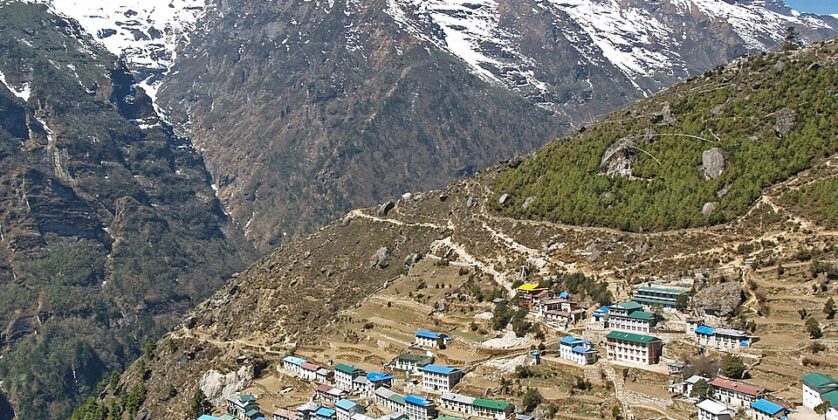
Tenzing Norgay (1914–1986) stands as one of the most important figures in the history of Himalayan mountaineering. Born and raised in Tengboche, in Nepal, and later a resident of India, Tenzing’s life reflected the shared Himalayan heritage that transcends modern borders.
Despite never learning to read or write, Tenzing possessed an exceptional intelligence and was fluent in several languages. More importantly, he had a deep understanding of mountains, weather, teamwork, and leadership. At a time when most Sherpas were employed only as high-altitude porters, Tenzing distinguished himself as a true climber, driven not only by work but by passion.
He participated in multiple Everest expeditions before success, serving as a high-altitude porter on British expeditions in 1935, 1936, and 1938, and later as a climbing member of the 1952 Swiss expedition, where he and Raymond Lambert reached a then-record height of 8,595 meters—just short of the summit.
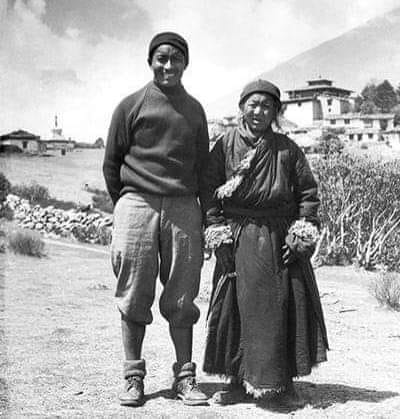
A Himalayan mountaineer walks with his mother to Tengboche Monastery in 1953 to receive blessings before departing on a landmark Mount Everest expedition. Credit: Royal Geographical Society
The Long Road to Everest’s Summit
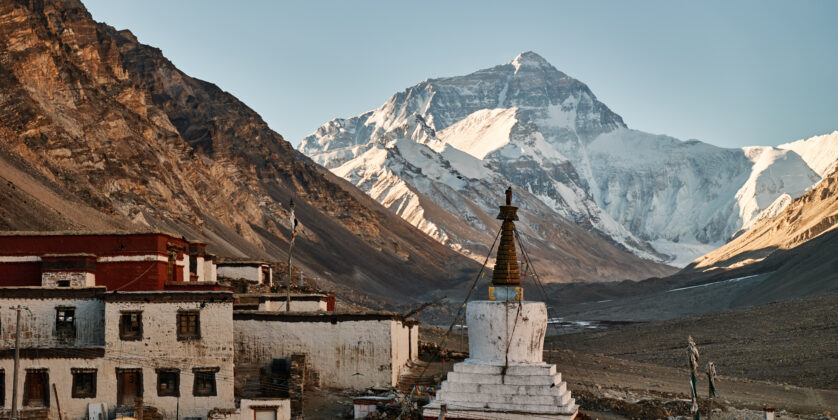
Mount Everest, identified as the highest mountain in the world in the mid-19th century, fascinated climbers for decades. Early British expeditions approached from the Tibetan (north) side, but political changes after World War II closed that route. Attention then turned to Nepal, opening the now-famous South Col route.
The Swiss expedition of 1952 proved the route was viable. This success set the stage for what would become one of the greatest achievements in mountaineering history—the 1953 British Mount Everest Expedition.
The 1953 British Mount Everest Expedition
Led by Colonel John Hunt, the 1953 expedition was the ninth attempt to climb Everest and the first to succeed. It was a massive, carefully planned operation involving climbers, doctors, scientists, cameramen, journalists, Sherpas, and hundreds of porters.
Training took place in Snowdonia, Wales, and the team departed England in February 1953. After arriving in Kathmandu—then a city with no hotels—the expedition moved toward Everest with more than 400 people and nearly 10,000 pounds of equipment.
Tenzing Norgay served as Sirdar (leader of the Sherpas) and was already widely respected as one of the most experienced Everest climbers in the world. For him, this was his sixth attempt on the mountain.
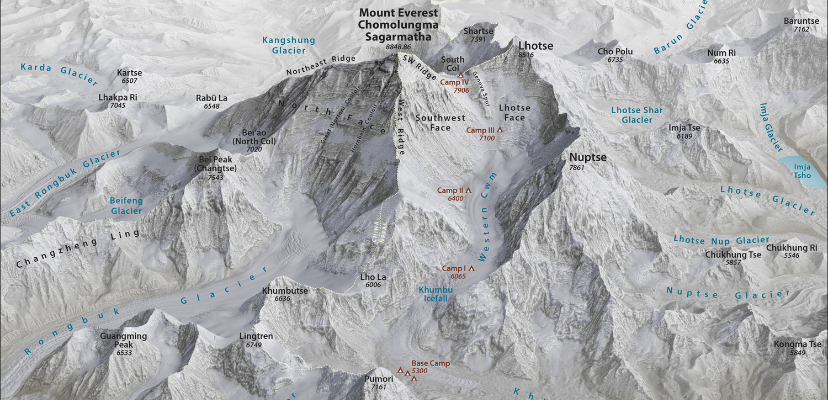
A detailed 3D topographic visualization of Mount Everest and the surrounding Himalayan range, highlighting major peaks, glaciers, and standard climbing routes from Base Camp to the summit.
The Climb: From Base Camp to the South Summit
The British team established a series of camps through the dangerous Khumbu Icefall, across the Western Cwm, and up the steep Lhotse Face to the South Col.
On 26 May 1953, the first summit attempt by Tom Bourdillon and Charles Evans reached the South Summit but had to turn back due to oxygen problems.
Two days later, it was the turn of Edmund Hillary of New Zealand and Tenzing Norgay of Nepal.
29 May 1953: Everest Is Finally Climbed
Leaving Camp IX early in the morning, Hillary and Tenzing climbed steadily toward the summit. After overcoming the final obstacle—now known as the Hillary Step—they reached the top of the world at 11:30 a.m. on 29 May 1953.
They spent a short time on the summit, taking photographs and leaving symbolic items in the snow. Tenzing placed sweets as an offering, while Hillary left a small cross.
Their success was kept secret until confirmation reached London—timed perfectly to coincide with the coronation of Queen Elizabeth II on 2 June 1953.
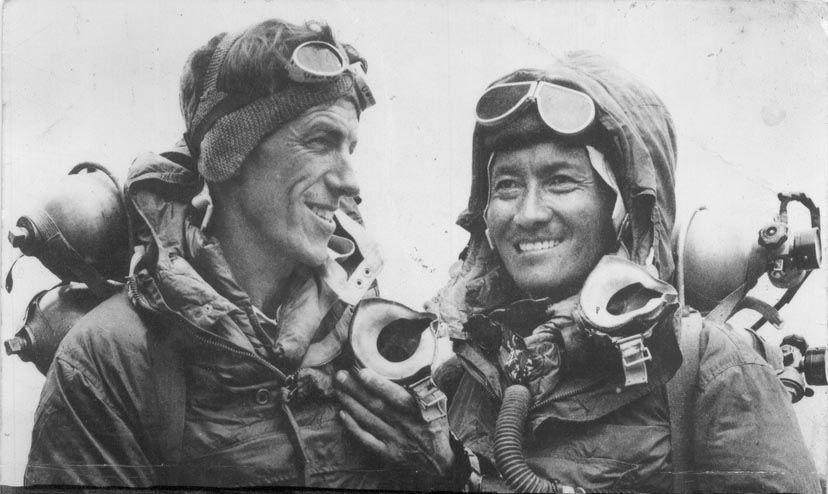
Tenzing Norgay and Edmund Hillary photographed shortly after completing the world’s first successful ascent of Mount Everest on 29 May 1953 at 11:30 am. Credit: Jamling Tenzing Norgay
Recognition, Respect, and Legacy
Edmund Hillary was knighted, while Tenzing Norgay received the George Medal, along with honors from Nepal and India. Although debate once surrounded who stepped onto the summit first, both climbers consistently emphasized that the achievement was a team effort.
Tenzing later clarified that Hillary reached the summit moments before him, but history remembers them together—as partners who proved Everest could be climbed.
Beyond Everest, Tenzing became a global ambassador for mountaineering and Himalayan culture. He inspired generations of Sherpas to be recognized not only as helpers, but as elite climbers and leaders.
Everest Today and the Spirit of Tenzing
Today, thousands of trekkers and climbers follow the paths pioneered by early explorers and climbers like Tenzing Norgay. Every journey through the Khumbu region carries echoes of his determination, humility, and courage.
At Mission Nepal Holidays, we honor this legacy by offering responsible trekking and mountaineering experiences that respect the mountains, the people, and the history that shaped them.
Walk in the Footsteps of Legends
Whether you dream of standing at Everest Base Camp, trekking through Sherpa villages, or simply learning about Himalayan history, the story of Tenzing Norgay reminds us that greatness comes from perseverance, teamwork, and respect for nature.
Join Mission Nepal Holidays and experience the Himalayas where history was made.