10 Facts About Mount Kailash: Separating Sacred Truth from Fringe Theories

Activities Highlights

When travelers first hear about Mount Kailash, they encounter a storm of wild theories: alien pyramids, time dilation, secret Nazi expeditions, and claims of advanced ancient technology. But what is the Sacred Truth?
The reality is far more profound. Kailash Mansarovar isn’t a mystery waiting to be solved by scientists or conspiracy theorists; it is a living spiritual heart beating for four major religions across Asia. For thousands of years, pilgrims have journeyed across harsh terrains to simply glimpse this peak. Here are the 10 essential facts that separate the divine reality from the fringe fiction.
1. It is impossible to climb Mount Kailash Due to Faith, Not Physics
The most common question asked about Mount Kailash is: Why hasn’t anyone reached the summit despite modern mountaineering technology?
The Sacred Truth is simple and direct: it is forbidden, not impossible. At 6,638 meters (21,778 feet), Mount Kailash is not even in the top 100 highest peaks in the Himalayan or Trans-Himalayan region. Technically, it is climbable. There are no impossible vertical walls or extreme weather anomalies preventing a summit attempt.
However, no nation issues permits to climb it. Why? Because Hindus believe it is the earthly abode of Lord Shiva and Goddess Parvati. Jains believe it is the site where their first Tirthankara, Rishabha Deva, attained Nirvana. Buddhists see it as the seat of Chakra Sambara and Vajra Yogini. Followers of the ancient Bon religion view it as the spiritual center of the universe. To put a boot on that summit would be an act of war against faith. The Sacred Truth is that some mountains are meant for worship, not conquest.
2. The ” Mount Kailash Pyramid” Theory is False (It’s Natural Geology)
You may have read Russian theories claiming Mount Kailash is a hollow, man-made pyramid built by an advanced lost civilization. Some even suggest it is connected to other pyramids worldwide via energy lines. That is a myth.
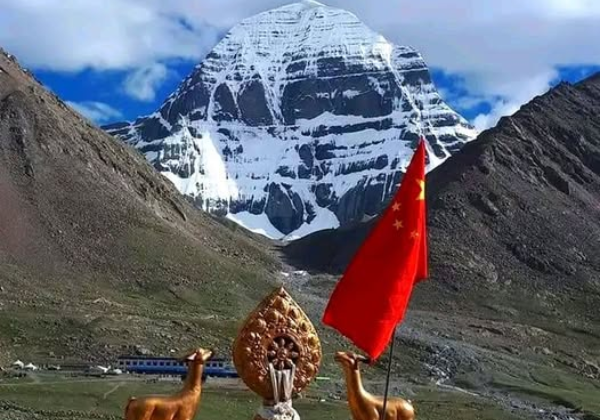
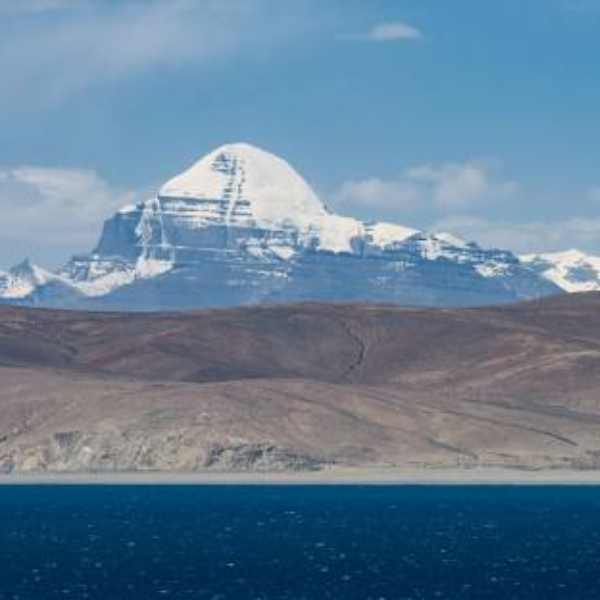
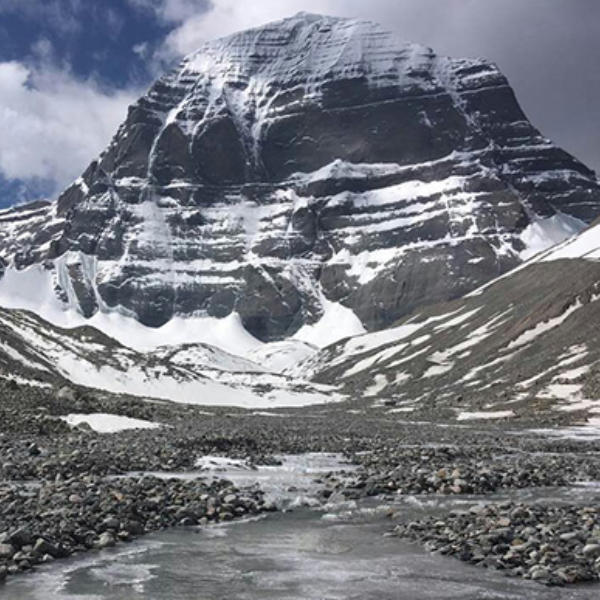
The Sacred Truth is that the mountain’s striking four-sided, cathedral-like shape is due to natural conglomerate rock erosion over millions of years. Geologists explain that the mountain is composed of sedimentary rock that tilted and eroded at specific angles, creating its famous flat faces and sharp edges. It looks divine because nature carved a temple out of stone—not because ancient engineers built a vacuum chamber. The beauty of Kailash Mansarovar is that nature itself created something that appears supernaturally perfect.
3. Four of Asia’s Mightiest Rivers Begin from Mount Kailash
One of the most mind-bending geographical facts about Kailash Mansarovar is hydrology. Four major rivers, stretching over 3,000 kilometers each, originate within just 50 kilometers of the peak of Mount Kailash.
These rivers are:
-
The Indus River (Singge Khabab) – flows West into Pakistan and the Arabian Sea
-
The Sutlej River – flows West through Tibet and India
-
The Brahmaputra River (Yarlung Tsangpo) – flows East through Tibet, India, and Bangladesh
-
The Karnali River (Ghaghara) – flows South into Nepal and joins the Ganges
Feeding over 1 billion people across China, India, Pakistan, Nepal, and Bangladesh, Mount Kailash is literally the “water tower of Asia.” The Sacred Truth is that one mountain sustains nearly one-seventh of humanity’s fresh water. Pilgrims believe this is not a coincidence but a divine gift.
4. The “Om” and Swastika are Natural Shadows in Mount Kailash
Many pilgrims return from Kailash Mansarovar with stunning photographs showing the sacred “Om” symbol or a Swastika clearly visible on the mountain face. Some believe these are ancient carvings or alien markings.
The Sacred Truth is that these aren’t man-made carvings at all. During sunset, the unique 90-degree angle of the mountain’s gullies and ridges casts shadows that naturally form these holy symbols. The snow accumulates in specific crevices, creating the perfect shape of “Om” on a nearby peak called Om Parvat. The Swastika appears as the sun sets behind Mount Kailash, casting a shadow that branches out in four directions. For believers, this natural phenomenon is seen as divine confirmation of the mountain’s spiritual power—a signature from the cosmos itself.
5. Lake Manasarovar is a Freshwater Miracle
The Kailash Mansarovar region features two lakes sitting right next to each other, separated by just a thin strip of land. Yet they could not be more different.
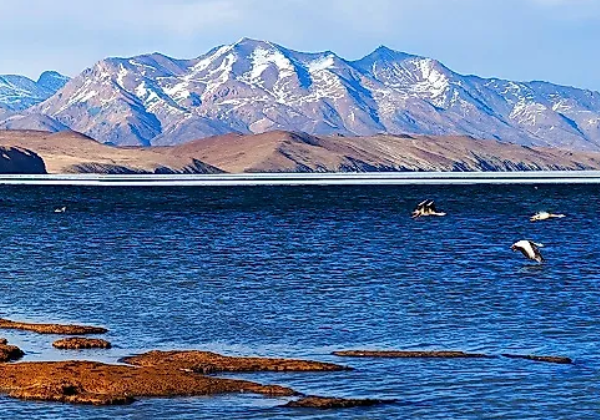
Lake Manasarovar is fresh, calm, circular, and crystal clear. It is one of the highest freshwater lakes in the world at 4,590 meters. Rakshas Tal (Lake of Demons) is salty, turbulent, irregular in shape, and has no outflow.
The Sacred Truth? They are separated by a thin strip of land representing the thin line between the divine mind and the ego. Manasarovar symbolizes light, purity, and consciousness. Rakshas Tal symbolizes darkness, chaos, and the untamed mind. Pilgrims bathe in Manasarovar to purify their souls, but no one touches Rakshas Tal. The two lakes exist in perfect balance—a geographical metaphor for the human condition.
6. The Kalash People Link to an Ancient Past
The Sacred Truth about Mount Kailash extends far beyond Tibet into the remote valleys of Pakistan. An indigenous tribe called the Kalash people lives in the Chitral Valley, surrounded by the Hindu Kush mountains.
Who are they? They practice an ancient form of Vedic Hinduism mixed with animism and shamanism. They worship a supreme deity named Mahandeu—which sounds remarkably similar to Mahadev (Lord Shiva). They celebrate festivals that resemble ancient Vedic rituals, offer animal sacrifices, and maintain a polytheistic pantheon including Indra, Yama, and Varuna. Most fascinatingly, many Kalash families share the surname “Kailash.”
The Sacred Truth is that the Kalash people are a living time capsule—a window into how the original culture of Kailash Mansarovar might have looked thousands of years ago before modern religions formalized. They are being persecuted in Pakistan, with only a few thousand remaining, but their very existence proves the deep historical roots of Mount Kailash worship.
7. The 52-Kilometer “Kora” around Mount Kailash Resets Your Karma
The ultimate ritual of Kailash Mansarovar is the Parikrama, also known as the Kora—a 52-kilometer (32-mile) circumambulation around the base of Mount Kailash.
Pilgrims typically complete this walk in 3 days, crossing the high pass of Dolma La at 5,636 meters. The rules are specific:
-
Hindus and Buddhists walk clockwise, following the direction of the sun.
-
Bon practitioners walk counter-clockwise, following their ancient tradition.
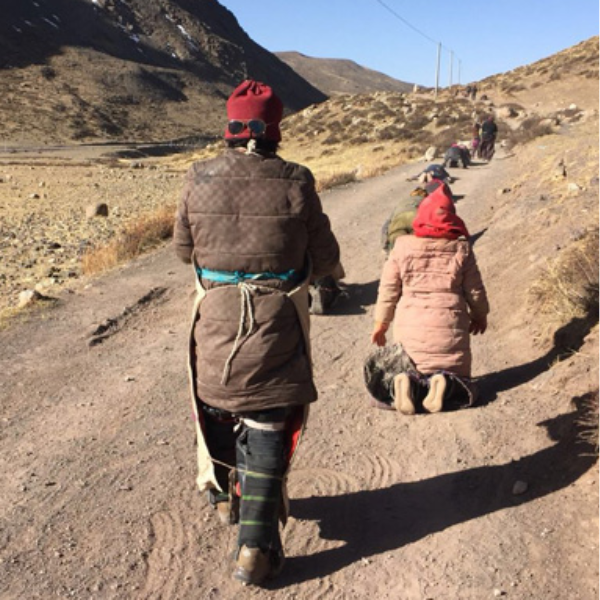
The Sacred Truth is that completing this trek is believed to wash away the sins of an entire lifetime. Doing 108 rounds (which takes years) guarantees enlightenment and liberation from the cycle of rebirth. Many pilgrims perform full-body prostrations along the entire route—lying flat, rising, stepping forward, and lying flat again. This takes weeks. The physical suffering is considered the price of spiritual purification. The Kora is not a hike; it is a moving meditation.
8. Only One Man “Reached” the Summit (Via Legend)
While no modern climber has ever scaled Mount Kailash, legend holds that one man did reach the summit nearly a thousand years ago—the Tibetan Buddhist saint Milarepa.
The story is central to the Sacred Truth of the mountain. Milarepa, a master of meditation and tantra, entered a contest with a Bon priest named Naro Bonchung. Whoever reached the summit first would claim the mountain for their religion. Naro Bonchung flew up the side of Mount Kailash on a magic drum, confident in his victory. But Milarepa, sitting calmly at the base, simply caught a ray of sunlight and rode it to the top, landing just before his rival.
The moral of this legend is profound: Mount Kailash cannot be conquered by ego, magical tricks, or physical strength. It can only be reached by spiritual merit, humility, and inner realization. Even today, no climber has attempted to disprove this legend. The Sacred Truth is that the mountain remains unconquered—keeping Milarepa’s victory eternal.
9. The Snow Cap is a Symbol of Eternity
It is often said that the snow on the peak of Mount Kailash never melts. Is that scientifically true? Not exactly. Snow does sublimate (turn directly into vapor) and seasonal changes affect the snow line.
But the Sacred Truth is symbolic, not literal. The perpetual white cap of Mount Kailash represents Lord Shiva’s eternal meditation—unmoved, unchanged, and unaffected despite the chaos of the material world below. While empires rise and fall, while climates shift and seasons change, the peak remains white. It is a reminder that there is something beyond the temporary: a state of absolute stillness and awareness. Pilgrims look at the snow cap and see not frozen water but frozen time—eternity made visible.
10. It is the “Axis Mundi” (The Center of Everything)
Why is this one mountain, among thousands in the Himalayas, considered so important? The answer lies in the concept of the Axis Mundi—the cosmic axis around which the universe revolves.
In Hinduism, Mount Kailash is considered Mount Meru, the center of all physical, metaphysical, and spiritual universes. The Vedas and Puranas describe it as the navel of existence, where heaven and earth connect. The stars, planets, and constellations revolve around it in the cosmic order. Similarly, Buddhists see it as the center of the mandala of existence.
The Sacred Truth of Kailash Mansarovar is that it serves as a bridge between Earth and Heaven. It is not a mountain you “conquer” like Everest, where climbers plant flags and take selfies. It is a mountain you witness, revere, and walk around to remember how small you are and how vast the divine truly is. In a world obsessed with achievement, Mount Kailash demands humility. That is its final lesson.
Final Thought
Don’t look for aliens, time dilation, or Nazi secrets at Kailash Mansarovar. Look for the Sacred Truth: a peak that has commanded the devotion of billions of people for thousands of years without a single footprint on its summit. Four religions, countless pilgrims, and endless legends all agree—this mountain is special not because of what scientists can measure, but because of what believers have always felt. That is the real miracle. That is the Sacred Truth of Mount Kailash.
Contact us to book your Kailash Mansarovar Yatra today.